Süleymaniye Mosque Restoration Reveals Hidden Jars in Dome
Restorer Kaya Ucer says clay jars in Sinan's dome soften echoes, as the mosque marks its 1557 opening.
The Süleymaniye Mosque restoration in Istanbul has uncovered clay jars hidden in the dome, according to a member of the restoration team. The finds come as the mosque marks the anniversary of its opening for worship on 15 October 1557. They show how closely Mimar Sinan, the chief Ottoman architect, thought about sound as well as space.
Kaya Ucer, a faculty member at Mimar Sinan Fine Arts University, worked on the project. He says the team also found original paintwork, an unusual metal-backed inscription and a missing piece of the courtyard fountain.
Süleymaniye Mosque restoration and the dome’s acoustic jars
Ucer says a legend had passed from mouth to mouth for years: that jars built into the dome damaged the mosque’s acoustics. Nobody had actually seen them. Scaffolding of 20,000 cubic meters finally gave his team access to the whole interior.
In cracks in the dome, the team spotted jars set among the bricks. After some initial doubt, they found them standing upright in zigzag lines at set intervals across the entire dome. Each has a hole in its base.
From below, the jars cannot be seen. From above, Ucer says, it becomes clear that the holes soften sound and cut off echoes. He says specialists ran tests, which ended the old myth that the jars harm the acoustics.
Paint layers, calligraphy and a missing letter
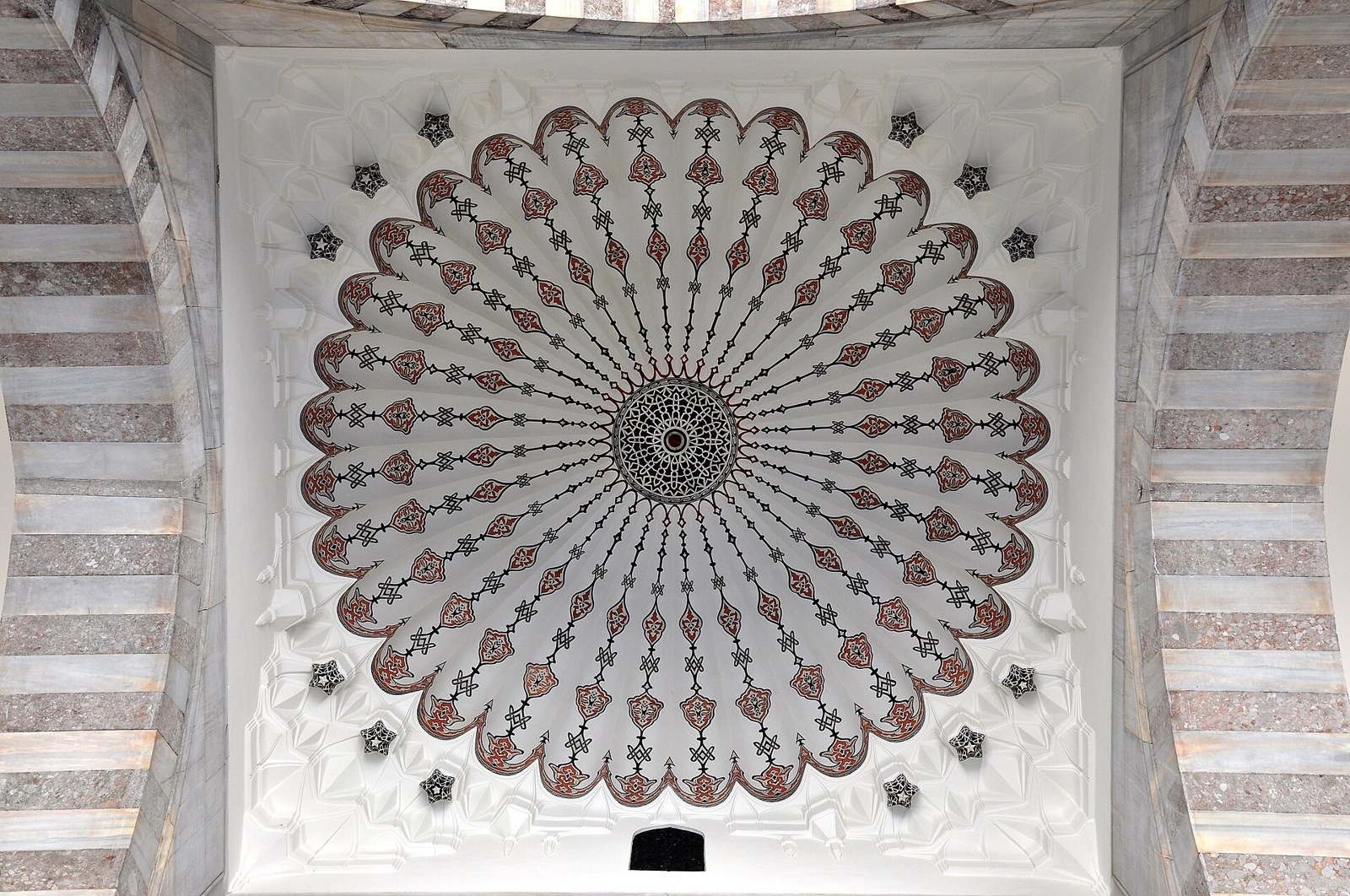
The dome surprised the team in another way. Although Sinan designed the mosque, the dome carries lavish Baroque, even Rococo-style, decoration with dense floral bouquets. The team studied nearly all of the main dome under ultraviolet light and scraped small patches to reach lower layers.
They found a second Baroque design underneath, but only in one section. Ucer reads this as a sign that two samples were made and the preferred one was continued. The team restored the decoration visible today.
The dome’s calligraphy is traditionally linked to Ahmed Karahisari, a renowned 16th-century calligrapher. Ucer says records instead name his student, Hasan Celebi, as the writer. They also say Abdulfettah Efendi made corrections in an 18th-century restoration.
Behind the wide, gold-leafed, wood-framed inscription, the team found a zinc base. Its panels are nailed together with large black-headed nails, and the writing sits over the rustproof metal. Ucer calls it the only example he has seen.
The team also noticed a missing letter in the dome inscription. After consulting calligraphers, a scientific panel agreed the letter belonged there, and the letter “h” was added.
Original Sinan-era motifs and a fountain fragment
Scraping in the portico and the sultan’s loge (the private section reserved for the ruler) revealed original paintwork from Sinan’s time. The team kept the original sections and restored missing parts based on them. Ucer says classical designs came to light, including rumi motifs, the Ottoman scrolling arabesque pattern widely used in the 16th century.
At the ablution fountain, pieces were missing from the top of the water-level tower. Ucer remembered a fragment at a museum run by the General Directorate of Foundations in Istanbul’s Fatih district. After measuring it and checking the pattern, the team cleaned the piece and set it in place. He says it fit the broken part exactly.
Why the mosque matters to Ottoman history
Sultan Suleiman the Magnificent ordered the mosque, and Sinan built it. It stands at the center of a complex with madrassas (religious schools), a hospital, a soup kitchen and a bathhouse. Together they reflect Ottoman urban planning and social life. Sinan himself described the building as his “journeyman” work, the stage before the master.
Ucer says construction took about seven years and the restoration took a similar length of time. He expects the building to need no major intervention for the next 50 years.
These findings come from the restoration team’s own account. Further technical publications may add detail on the acoustic tests.
Source: Türkiye Today
Featured image: Moonik / Wikimedia Commons, CC BY-SA 3.0