Arife Throne: Sultan Ahmed I’s Mother-of-Pearl Masterpiece
Sultan Ahmed I's inlaid Arife Throne is on display in Topkapı Palace's Revan Pavilion.
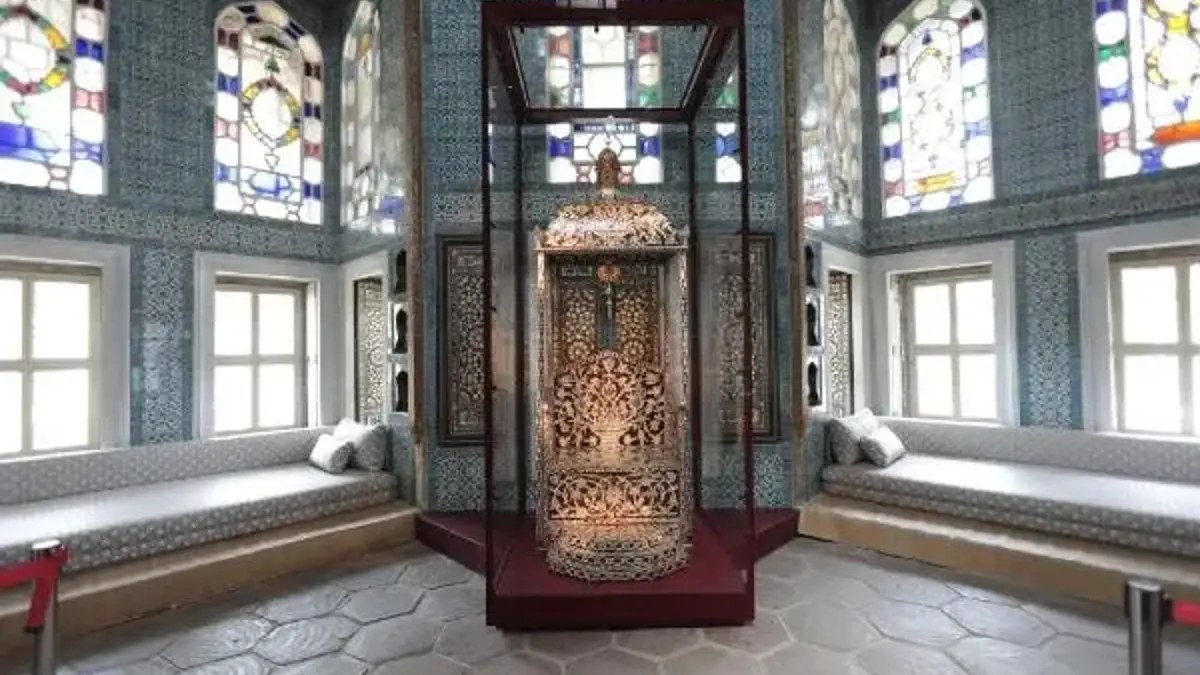
The Arife Throne at Topkapı Palace is one of the finest surviving examples of early 17th-century Ottoman craftsmanship. Commissioned by Sultan Ahmed I, it is covered in mother-of-pearl, tortoiseshell and gem-set flowers, and visitors can still see it in Istanbul today.
This walnut ceremonial seat was never an everyday throne. It had one specific job: to host the Sultan on the eve of the two great Islamic festivals.
What the Arife Throne looks like
The throne is built as a baldachin, a canopied seat of state. Three low steps lead up to the seat, and a domed canopy rises above it.
The decoration is what sets it apart. Almost the whole surface carries inlay of mother-of-pearl and tortoiseshell. Tulips, carnations, roses and peonies grow from vases in a naturalistic style typical of the Classical Ottoman period.
Gold settings hold emeralds, jade, rubies and turquoise among the flowers. The pale mother-of-pearl catches the light, while the dark tortoiseshell works as a rich background.
Sedefkar Mehmed Aga and the Blue Mosque link
The throne is attributed to Sedefkar Mehmed Aga, a leading craftsman and architect of the Ottoman court. The title “Sedefkar” means a master of mother-of-pearl work. Turkish reporting also describes him as a mother-of-pearl master and the architect of the Sultan Ahmed Mosque.
According to Türkiye Today, he trained in the imperial tradition under the great architect Sinan. He became chief imperial architect in 1606. His best-known building is the Sultan Ahmed Mosque, better known as the Blue Mosque, built between 1609 and 1616.
The two works differ hugely in scale. Even so, both show the same concern for proportion, pattern and light. The mosque does it with domes, minarets and Iznik tiles. The throne does it with walnut, shell and stone.
How the Arife ceremony worked
In Ottoman usage, arife means “eve” and refers to the day before a Bayram, or religious festival. According to palace records and later descriptions, the throne stood before the Audience Chamber (Arz Odası) in the Third Courtyard. It appeared on the eve of both Ramadan Bayram and Kurban Bayram.
The Sultan came after the noon prayer and took his seat. Palace residents and members of the Enderun, the palace school, then came forward by rank to offer greetings. The ceremony continued until the evening prayer.
The next morning brought a more public ritual. After the Bayram prayer, the Sultan received ministers and officials seated on the Golden Throne in front of the Gate of Felicity.
Fans of Ottoman dramas may know such court rituals from the screen. A series can show them in a dramatised form, but the palace records and surviving objects like this throne are the stronger guide to how they worked. For more historical drama, Mehmed: Sultan of Conquests episodes are available on our site.
Where to see the Arife Throne today
The throne is on display in the Revan Pavilion in the Fourth Courtyard of Topkapı Palace. It moved there in 2021 from the Fatih Pavilion during renovations. Türkiye Today reports that it has stayed in the Revan Pavilion even though the Fatih Pavilion has since reopened.
The pavilion itself is later than the throne. Sultan Murad IV, Ahmed I’s son, built it to mark his 1635 victory at Yerevan. Visitors therefore see a 17th-century masterpiece in a setting that Ahmed I never knew.
Türkiye Today also notes a portrait of Sultan Selim III seated on the throne, by Joseph Warnia-Zarzecki, held at the Pera Museum. It shows the piece remained a powerful image of imperial ceremony long after Ahmed I’s reign.
Source: Türkiye Today
Featured image: CNN Türk