Pompeiopolis Mosaic Grows to 130 Square Metres in Kastamonu
Restoration continues as weather is expected to end the 2026 dig.
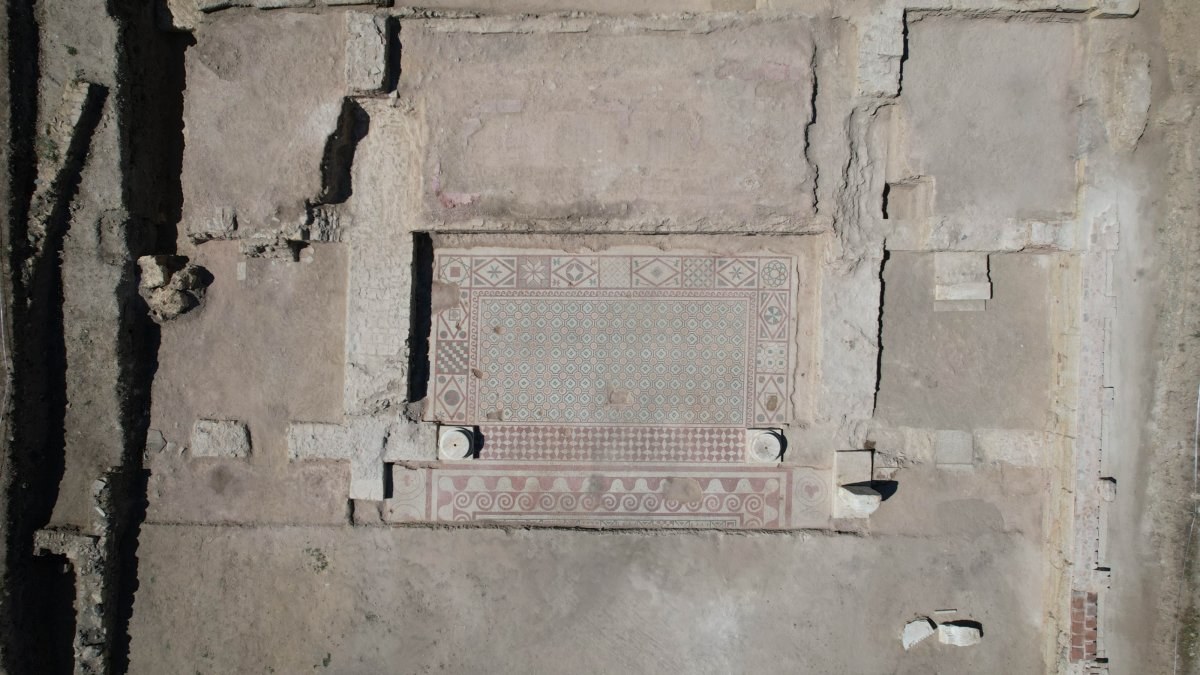
The 2026 excavation season at Pompeiopolis, an ancient city in Kastamonu’s Taşköprü district, has uncovered a Roman-era floor mosaic of about 130 square metres. Archaeologists also found a marble Eros head. Restoration of the Pompeiopolis mosaic is continuing, and the dig is expected to close soon because of winter weather.
The work is coordinated by the Ministry of Culture and Tourism. Assoc. Prof. Mevlüt Eliüşük of Karabük University leads the excavation, which has now run for 25 years.
What the Pompeiopolis mosaic and Eros head show
The mosaic lies in the basilica area. It dates to the 4th century AD, is built from geometric compositions and is described as very well preserved. The Eros head dates to the second half of the 2nd century AD.
Deputy excavation head Ahmet Yasin Ekinci said the team found the basilica’s foundation walls in 2025 and exposed its full plan in 2026. He described a three-aisled building with two construction phases, one in the mid-2nd century and one in the 5th century. The team measured a mosaic area of about 120 square metres across the central and eastern aisles. The Eros head came from the eastern pastophorion, a side room of an early church.
The figures differ slightly. Earlier reports in September cited about 105 square metres, while today’s report gives roughly 130. Taşköprü Mayor Hüseyin Arslan said the mosaic continues beyond the exposed area, so further digging is planned.
Restoration, weather and plans for visitors
Conservation is now the main task. Excavator Nisa Beygirlioğlu explained that the team removes old grout between the tiny stones (tesserae) and applies new grout. This makes the pattern clearer and limits movement of the stones.
The team covered the structure with a temporary roof soon after the discovery. Ekinci said a permanent roof is planned during the 2027 season. Poor weather has moved some conservation work into the laboratory, and the field season is expected to end shortly.
Local officials want to turn the site into an official archaeological site open to visitors. Arslan said the plans include walking routes linking the basilica and the Roman villa. A welcome centre is also planned, backed by a project submitted to the North Anatolian Development Agency (KUZKA). Arslan thanked the Culture Ministry and the sponsor Acacia Maden, and said faster digging depends on more sponsorship.
Why Pompeiopolis matters beyond the mosaic
The source calls Pompeiopolis the “Ephesus of the Black Sea region”. In Roman times it was the capital of Paphlagonia. Earlier seasons produced Aphrodite statues, the remains of a Roman villa, theatre remains, gravestones and inscriptions. In 2021, archaeologists also found a 2nd-century marble sundial of the hemicyclium type.
Officials plan to finish restoration work on the theatre next year. The team will also keep digging near the mosaic, since the floor extends further.
Source: SonDakika
Featured image: Daily Sabah